Johnny Trigger: Action Shooter
- 4.6
- Rating
- 100.00M
- Installs
- Free
- Price

 Analysis by App-foxy
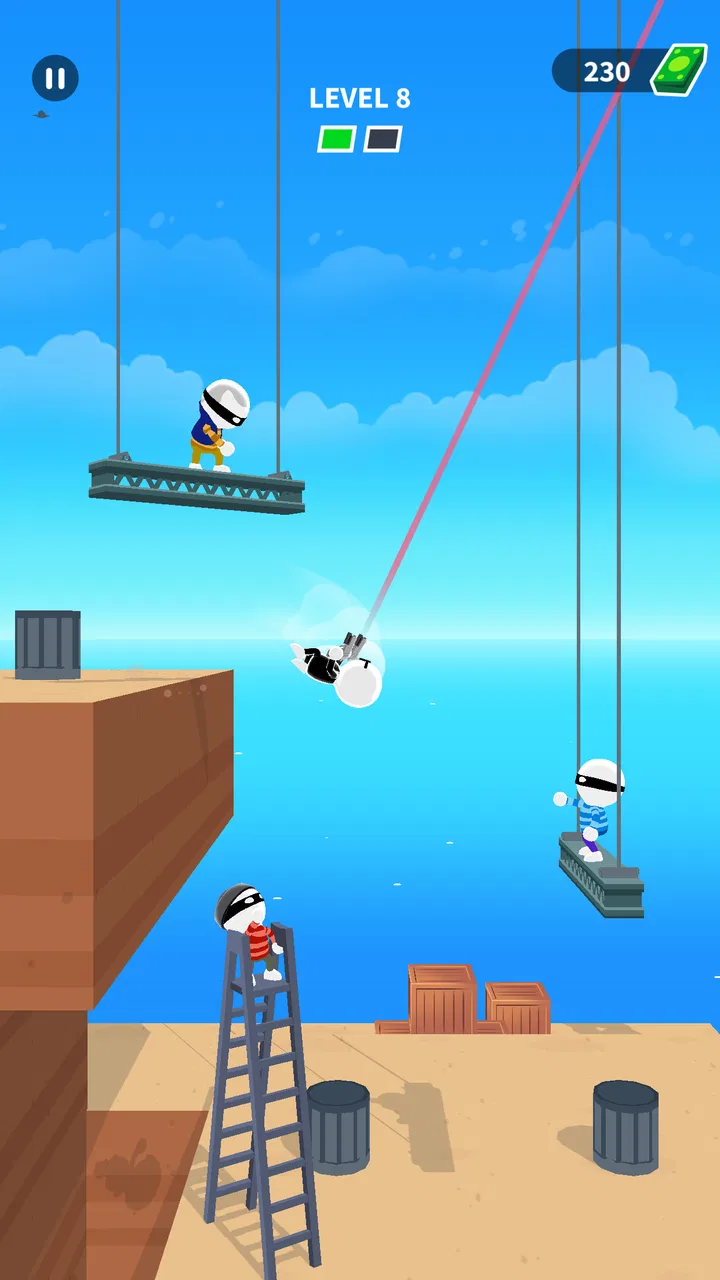
I spent time with Johnny Trigger: Action Shooter as a quick-fire mobile action game, and its appeal became clear almost immediately: it turns aiming and timing into short, readable challenges that are easy to start but surprisingly demanding when a stage stops giving you room for mistakes. The basic idea is simple, yet the presentation makes each encounter feel like a tiny action scene rather than a conventional shooting gallery.
That simplicity is also the reason I would not recommend it to everyone. If you want a deep campaign, a large arsenal to study, or a traditional shooter with constant control over movement, this is not the right fit. If you want something you can open for a few minutes, understand without a tutorial marathon, and play with one-handed attention, it makes much more sense. I found it especially suitable for short breaks, waiting rooms, and those moments when I wanted a game with immediate feedback rather than a long commitment.
Why the first few stages work so well
The early goals are easy to understand. You jump into an encounter, line up the action, and try to eliminate targets before the opportunity disappears. That direct structure gives every attempt a clear purpose. I never had to wonder what the game wanted me to do; the challenge was usually about reading the scene correctly and acting at the right moment.
You May Also Like

 Pandora - Music & Podcasts
Pandora’s Music Is Easy to Start, but Harder to Recover
Pandora’s strength is its low-effort path from a seed to a station. Its weak spot is how much confidence it asks you to place in connection, setup, and quiet recovery.

 AccuWeather: Weather Radar
AccuWeather Review: A Quick, Clear Forecast for Everyday Decisions
For everyday plans, the best forecast is the one you can understand quickly. AccuWeather makes rain timing, radar, and local conditions easy to act on, with a few trade-offs.

 Hill Climb Racing
Why Hill Climb Racing Still Turns Crashes Into One More Run
A tiny car, a bumpy hill and one more upgrade: Hill Climb Racing keeps resurfacing because its simple chaos makes every near-miss feel personal.

 AliExpress - Shopping App
AliExpress Makes Global Shopping Feel Personal, but Shoppers Bear the Risk
AliExpress turns a global marketplace into a pocket-sized discovery engine. Its reach is useful, its shopping loop compelling, and its trade-offs easy to miss.

 Lords Mobile: Kingdom Wars
Lords Mobile Is a Kingdom-Building Routine, Not a Quick Match
A case-by-case verdict on the building, battles, device demands, and social commitments that make Lords Mobile rewarding for some players and exhausting for others.

 PDF Scanner app - TapScanner
TapScanner Makes Paperwork Easier to Capture, Check, and Share
TapScanner makes scanning with a phone feel less like a rescue operation and more like a dependable step in getting work done. Its capture tools are useful, though not flawless.
More From Our News Desk
View All News


The important distinction is that the game does not feel like a standard twin-stick or virtual-button shooter. Its action is built around timing and positioning within a tightly staged sequence. That makes the first sessions approachable for people who dislike complicated touch controls. Instead of wrestling with several on-screen inputs, I could focus on watching the next opening and deciding when to commit.
Those opening levels also establish the rhythm that carries much of the experience. A successful move creates a satisfying sense of momentum, while a poorly timed shot can make the whole attempt collapse quickly. The result is a compact loop: observe, act, see the consequence, and try again if the plan failed. It is a good design for mobile play because the game rarely asks me to remember a large set of rules before I can enjoy it.
One useful habit is to resist tapping as soon as a target appears. The most reliable approach is to watch the complete sequence first whenever the game gives you a moment to do so. I often improved simply by treating each encounter as a timing puzzle instead of rushing toward the first visible enemy. That small change makes the action feel more deliberate and helps reveal why a stage went wrong.
The game’s secret-agent theme supports this structure without overwhelming it. I get the feeling of moving through brief set pieces, but the experience remains focused on the next action rather than on lengthy dialogue or a complicated plot. That is a strength for quick sessions, although players looking for a narrative-driven spy adventure may find the theme more decorative than substantial.
Progress you can feel without a complicated menu
Progress in this kind of game is less about building a detailed character sheet and more about becoming better at reading situations. The clearest signal is my own improvement: a sequence that initially seemed chaotic starts to make sense after a few attempts. I learn when to wait, which target deserves attention first, and how a jump changes the timing of the next action.
That personal learning is important because it gives the early goals more value than a simple checklist. Completing a stage is not only about reaching the next one; it is also evidence that I have understood the pattern the game is presenting. The satisfaction comes from turning a failed attempt into a clean run, especially when the solution depends on patience rather than faster tapping.
The presentation helps reinforce that feeling. Encounters are compact enough that I can remember what happened, and a restart does not feel like losing a large amount of progress. This encourages experimentation. I can try a different order, wait a fraction longer, or change my approach without feeling that an entire play session has been wasted.
There is a trade-off here. Players who measure progress mainly through extensive customization, equipment statistics, or a constantly expanding collection may find the development relatively light. The game’s reward is the next challenge and the improvement of execution, not a deep long-term build. That makes it accessible, but it also limits its appeal for anyone who needs a strong sense of ownership over a character or loadout.
I also like that the compact format makes it practical for uneven schedules. In an everyday situation, such as waiting for a bus with only a few minutes available, I can play a stage, fail, and understand exactly what I want to change next time. A longer action game might leave me searching for a save point or remembering several objectives. Here, the small scale is part of the convenience.
How the difficulty changes the pace
The difficulty curve works best when it asks for more careful timing rather than simply making everything faster. Early encounters let me learn the visual language of the game. Later situations put more pressure on the same basic skills, so the challenge feels connected to what I have already practiced instead of introducing an entirely different control scheme.
My main advice is to separate mistakes into two categories. If I failed because I acted too early, the answer was patience. If I failed because I ignored the order of threats, the answer was planning. Treating every loss as a reflex problem led to frustration, while identifying the actual cause made retries useful. That is one of the game’s more rewarding hidden lessons: quick action still benefits from a calm reading of the scene.
The pacing is strongest when a stage gives me enough information to form a plan and then tests whether I can execute it. It becomes less satisfying when I feel that success depends on guessing what the sequence expects. For that reason, I preferred replaying a level after a failure rather than immediately blaming the controls. A second attempt often exposed a detail I had overlooked.
Touchscreen action always brings some friction, especially when a player expects the precision of a console controller. I occasionally wanted more direct control over the character’s movement, but that would also change the identity of the game. Its limited input style is both its advantage and its boundary: it keeps the action readable on a phone, while reducing the freedom that experienced shooter players may want.
The Teen content rating is worth keeping in mind for families choosing games for younger players. The premise and action are clearly aimed at an older audience than a purely cartoon puzzle title. I would not treat the rating as a minor detail when deciding whether it belongs on a child’s device.
What keeps the short loop interesting
The retention pressure comes from the desire to complete the next encounter cleanly, not from a huge amount of downtime between attempts. That is effective because the game makes failure easy to understand and retrying relatively natural. When I knew that one timing decision had caused the problem, I usually wanted another attempt immediately.
Still, this design can create a familiar mobile-game tension. The same short loop that makes the game convenient can also become repetitive if I play for too long in one sitting. I enjoyed it more when I treated it as a series of brief sessions rather than trying to force a long evening out of it. The action has enough variety in its situations to sustain interest for a while, but it is not built around the broad exploration or dramatic mission structure of a full-scale action game.
The free price makes trying it easy, but the presence of in-app purchases ranging from $0.99 to $99.99 per item means I would approach spending carefully. I would first decide whether the basic loop itself is enjoyable before considering any optional purchase. A payment should not be the reason to continue a game that no longer feels fun, and this title is easiest to judge by playing its core encounters rather than by chasing every possible extra.
Another practical point is that the game is not best understood as a replacement for a competitive online shooter. I would choose it over one when I want a self-contained burst of action without matchmaking, team coordination, or a large time investment. I would choose a conventional shooter instead when I want free movement, weapon strategy, multiplayer tension, or a longer-term skill ladder based on live opponents.
It also compares differently with slower puzzle games. Johnny Trigger asks for visual timing and quick decisions, while a traditional logic game gives me more time to calculate. If I am mentally tired and want something calm, the shooter’s repeated action may feel more demanding than expected. Conversely, when I want immediate feedback and a clear consequence for each decision, it has more energy than a passive arcade experience.
Who will enjoy it, and who should pass
I think it is a strong match for players who enjoy arcade action, short levels, and retry-based challenges. It is also friendly to people who do not want to learn a complicated control layout. The one-handed, highly focused style suits quick breaks, and the concise encounters make it easy to stop without losing the thread of a long mission.
I would be more cautious recommending it to someone who needs a substantial story, extensive character development, or a large amount of strategic freedom. Players who dislike repeating a stage after a mistimed action may also find the loop irritating. The game rewards attention and patience, but it does not hide the fact that repetition is part of the route to mastery.
It is also not my first choice for someone seeking a realistic shooting simulation. The secret-agent presentation is playful and exaggerated, and the action is designed around clarity and spectacle rather than realism. That is exactly why it works as an accessible phone game, but it sets expectations differently from a serious tactical shooter.
From a platform perspective, the game supports devices running Android 8.0 or later. SayGames Ltd is the developer, and the current version is 1.12.61. Those details matter if you are installing on an older phone, because compatibility should be checked before planning to make it a regular part of your gaming routine.
My verdict on the progression
After playing through its rhythm of goals, retries, and increasingly demanding timing, I see the progression as focused rather than deep. The game succeeds when it lets me turn observation into action and action into visible improvement. It does not need a complicated progression screen to create that feeling; the next stage and the cleaner attempt are enough for players who enjoy compact arcade challenges.
Its broad reach reflects that accessibility. It has an average rating of 4.6 from around 1.7 million ratings, with over 100 million installs, which fits my impression that the basic concept is easy for a wide range of mobile players to understand. Those figures do not change the personal trade-off, though: popularity cannot replace the need to enjoy repetition, timing, and a relatively narrow control style.
For me, the best way to approach it is as a polished snack-sized action game. I would play a few stages during a spare moment, pay attention to why a failed attempt failed, and stop before the loop starts feeling mechanical. I would also keep the purchase model in mind and avoid spending until I was certain the core challenge had lasting value for me.
My recommendation is simple: try it if you want quick, timing-focused action with clear goals and low control complexity. Skip it if you are looking for a full campaign, deep customization, or the freedom of a traditional shooter. Within its chosen limits, it is an enjoyable and approachable game, and its strongest feature is not the promise of endless depth but the way it makes a short attempt feel worth repeating.
FAQs for Johnny Trigger: Action Shooter
01What is the premise of Johnny Trigger: Action Shooter?
Johnny Trigger: Action Shooter is an action-packed mobile game where players take on the role of Johnny, a skilled gunman on a mission to eliminate the underworld mafia. The game combines fast-paced shooting with strategic acrobatics, requiring players to time their shots while performing flips and stunts to take down enemies efficiently.
02How do the controls work in Johnny Trigger?
The game features intuitive one-touch controls, making it accessible for players of all skill levels. Players simply tap the screen to shoot as Johnny automatically runs and performs acrobatics. Timing is crucial, as players must shoot enemies during flips and avoid hitting hostages, adding a layer of strategy to the gameplay.
03Are there in-app purchases in Johnny Trigger?
Yes, Johnny Trigger includes in-app purchases. Players can buy various items, such as special weapons and skins, to enhance their gaming experience. While the game is free to download and play, these purchases can help progress faster or personalize Johnny’s appearance, though they are not necessary to enjoy the game.
04What are the graphics like in Johnny Trigger?
Johnny Trigger boasts minimalist yet stylish graphics, with smooth animations and a cartoon-like aesthetic. The simplistic design ensures that the focus remains on the action, providing a visually pleasing experience without overwhelming players with excessive details, making it suitable for both casual and hardcore gamers.
05Is Johnny Trigger suitable for all ages?
Johnny Trigger is generally suitable for older children and adults due to its action-focused gameplay involving guns and shooting. While the violence is stylized and cartoon-like, parents might want to evaluate whether it aligns with their comfort levels for younger children. The game does not contain graphic content but involves shooting enemies.
Pros
- Smooth and responsive controls.
- Engaging and dynamic levels.
- Stylish graphics and animations.
- Wide range of weapons to unlock.
- Free to play with optional in-app purchases.
Cons
- Ads can be intrusive at times.
- Limited storyline depth.
- Some levels feel repetitive.
- In-app purchases can be pricey.
- Requires internet for some features.

Johnny Trigger: Action Shooter
Gallery